Collaborative AI that turns any classroom into an active learning environment
Engage the whole room and learn better together.


Simple setup,
big results
- Frictionless, one-time classroom setup that works every session
- Seamless integration with any lecture style, content, or approach
- Built for where education is going, not where it's been
Zero-prep engagement
- Groups that report back: Colaj follows each group's conversation and brings every answer to the front of the room
- Polls drafted from your lecture, answered in students' own words
- Q&A that's anonymous, so anyone can ask, and the room upvotes what matters most
After-class takeaways to create better outcomes
- Collaborative study guide extends social engagement beyond the classroom
- Feedback to fine-tune lessons and teaching approach
- Measurable engagement without the overhead
A shared canvas for the whole room
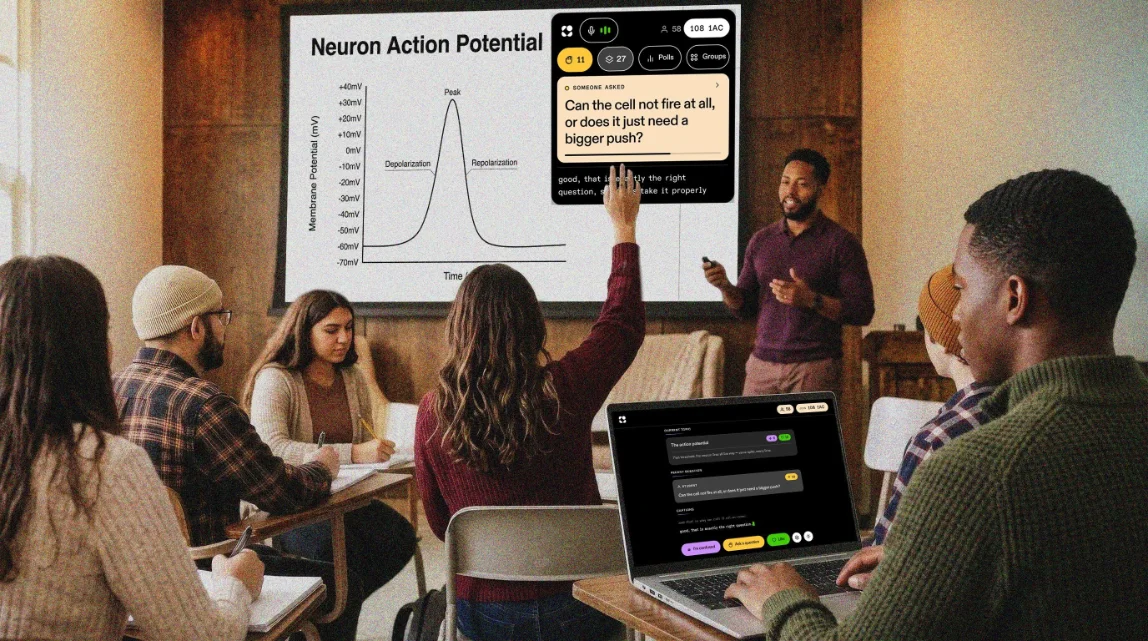
Colaj sits in a corner of the front screen, right on top of your slides. Everyone in the room sees the same thing: live captions, the topic at hand, and the questions students are asking.
Students join from their own devices with a code, with no account and no name attached. What they add goes up where the whole class can see it, so a question from the back row becomes something the room works through together.
The AI listens, organizes what it hears, and hands the room back to you. The teaching stays yours, and the thinking stays theirs.
 58108 1AC
 Captions and questions, live on the front screen
Colaj captions your lecture as you talk, in the corner of the screen everyone is already looking at.
When a student asks something, it goes up for the whole room for 20 seconds, then waits in your Questions drawer. Students upvote each other's questions, so the ones the room cares about rise to the top.
Run, follow and synthesize group work
Send a prompt to small groups, or pick one of two Colaj suggests from your lecture. One phone at each table listens (the audio is never stored), and each group's summary updates as they talk, so you can follow every table from the front.
When time's up, Colaj brings the room back together. The shared screen shows the themes the groups landed on and every group's answer, each marked with its own letter and colour. It all goes into the study guide.
Built at the request of our pilot instructors, for active learning and flipped class time.
Group workWhen wood burns, it ends up as a small pile of ash. Where did the rest of the mass go? Agree on one answer.
Most of the wood goes up as smoke, so the ash is just what was left behindIt turns into carbon dioxide and water vapour, gases that float off into the air
Mass can't just disappear, so it has to be going somewhere we can't seeNone of it is lost: if you trapped all the smoke and gas, the total would weigh the same
Listening · first summary soonNot sure: we think some of the mass gets used up and turns into heat and light
When wood burns, where does the rest of the mass go?
Most groups say the mass leaves as gas; one group thinks some of it is used up as heat and light.
3 of 3 groups answered
Live pollIn your own words, why does a combustion equation have to balance?
What breaks if you change a subscript instead of a coefficient?
In your own words, why does a combustion equation have to balance?
Your response is anonymous. Hang tight while the rest of the class answers.
In your own words, why does a combustion equation have to balance?
Why does a combustion equation have to balance?
Polls written in the moment, with zero prep
Colaj listens to your lecture and drafts poll questions from what you just said. Send one in a tap — no slide prep, no question bank, no breaking your stride.
Students answer in their own words, not by picking A, B, or C. Colaj clusters those answers into comprehension bands and surfaces the misconception hiding inside them — so you know what to re-teach before you move on.
Every class becomes study material
The class ends. But the conversation doesn't have to. Colaj automatically generates a study guide from each session: a structured synthesis of what was covered, answers to the questions the room asked, and the key concepts worth revisiting.
For the instructor, it hands them a ready-made bridge into the next class. Open with what confused people last time. Build on what landed. The learning cycle isn't a series of isolated sessions. Colaj helps make it feel like one continuous conversation.
What was actually discovered during those 2,000 years of alchemy?
None of this is new pedagogy — the overhead is what we removed
Active learning, retrieval practice, and formative assessment are among the most studied ideas in education. In a review of 225 studies, students in traditional lectures were 1.5× more likely to fail than those in active-learning sections. What keeps those methods out of most classes is the cost of preparing and running them.
Freeman et al., 2014
Captions are a learning aid
Across 2,100 students at 15 universities, 75% used captions as a learning aid — only 13% were registered with disability services. A review of more than 100 studies found captions benefit comprehension and memory, not only for deaf and hard-of-hearing viewers.
Linder, Oregon State, 2016 · Gernsbacher, 2015
Anonymity changes who speaks
Given an anonymous channel, participation jumped to nearly the whole room and answers got more honest. In large intro biology, men’s voices dominated whole-class discussion even where women performed equally.
Stowell & Nelson, 2007 · Eddy, Brownell & Wenderoth, 2014
Writing the question is the learning
Generating your own question is constructive rather than passive — a full level above listening. Across 26 studies, teaching students to generate questions reliably improved comprehension.
Chi & Wylie, 2014 · Rosenshine, Meister & Chapman, 1996
Checking while you can still act
Formative assessment — checking understanding during instruction and adjusting to it — is among the most robust interventions studied. Across ten years of data, pausing to check conceptual understanding and respond roughly doubled learning gains in physics.
Black & Wiliam, 1998 · Crouch & Mazur, 2001
Answering beats re-reading
Being tested on material beats studying it again — a week later, tested students retain far more. Of ten study techniques reviewed, only practice testing and spaced practice earned the top rating. Colaj automates both, with zero authoring.
Roediger & Karpicke, 2006 · Dunlosky et al., 2013
Belonging and structure close gaps
A one-hour intervention showing students that worries about fitting in are normal and shared raised GPA over three years and halved the minority achievement gap. Adding regular low-stakes engagement helped everyone, and roughly halved the achievement gap for Black students.
Walton & Cohen, 2011 · Eddy & Hogan, 2014
Colaj is engineered around these mechanisms, and we're piloting now with instructors and universities to show the links hold in their classrooms.
Built for innovative educators
Students deserve to feel connected to what they're learning. Colaj puts AI in service of that connection: the instructor still teaches, the student still thinks, and Colaj carries everything in between. It lowers the barrier to speaking up, so every voice in the room can reach the front of it.
Colaj was launched by SOSO, an MIT-founded design studio with 20 years of experience creating connection and engagement through digital experience.